
During 2024, Madrileña Red de Gas’s environmental management focused on consolidating and strengthening its Environmental Management System in accordance with ISO 14001 requirements. This effort allowed them to not only maintain their international certification but also drive continuous improvements in environmental performance.
Having ISO 14001 certification represents a strategic advantage for Madrileña Red de Gas, as it demonstrates their commitment to sustainability and proactive environmental management. It also enables them to identify and mitigate environmental impacts from business activities, ensuring compliance with current regulations and promoting continuous improvement.
Having ISO 14001 certification represents a strategic advantage for Madrileña Red de Gas, as it demonstrates their commitment to sustainability and proactive environmental management
Additionally, for the third consecutive year, an external verification of the previous year’s carbon footprint was carried out. Subsequently, it was registered with the Spanish Office for Climate Change (OECC), obtaining the CALCULATION seal corresponding to 2023.
Furthermore, in 2024, Madrileña Red de Gas worked on implementing an action plan aligned with the OGMP 2.0 initiative. This plan is designed to contribute to reducing methane emissions from their activities, establishing a clear path toward sustainability and achieving their environmental objectives.
Finally, it’s important to highlight that during 2024, no accidents with environmental impacts resulting in fines or civil liability were recorded.
8.1Impact on climate change
As discussed throughout this report, and particularly in Chapter 5.2 on “Climate Adaptation, Resilience, and Transition,” Madrileña Red de Gas addresses the risks associated with climate change and the energy transition through a firm commitment and a solid strategy.
Under this context, establishing greenhouse gas (GHG) emission reduction targets is not only an ethical responsibility in the face of climate change, but also a key strategy to mitigate environmental impact, align with global climate policies, optimize energy efficiency, and better manage risks derived from future environmental regulations.
Graphics shows the specific objectives Madrileña Red de Gas has established to reduce its climate impact and contribute to a more sustainable future.
Regarding the first objective, Madrileña Red de Gas achieved a 15.19% reduction in its total carbon footprint compared to the previous year, as detailed in the following sections.
Concerning the second objective, during 2024, 5 out of the 9 action lines defined in the implementation plan for methane emission reduction were executed, representing 55.5% progress. Additionally, the company obtained the Gold Standard Pathway certification (see the “Climate Adaptation, Resilience, and Transition” chapter for more details), reflecting its commitment and positive performance in this area.


2024 Carbon Footprint: reduction and climate commitment
The quantification of greenhouse gas (GHG) emissions is a fundamental tool for Madrileña Red de Gas to measure and generate an indicator of the impact of its activities and processes on climate change.
It not only allows them to quantify their contribution to the phenomenon but also serves as a valuable management tool to identify actions that are increasing their emissions, as well as opportunities to improve and optimize resource use more efficiently.
The quantification of greenhouse gas (GHG) emissions is a fundamental tool for Madrileña Red de Gas to measure and generate an indicator of the impact of its activities and processes on climate change
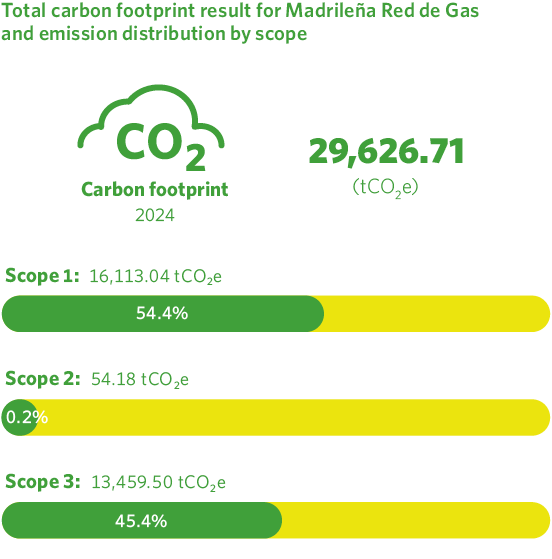
Thus, as in previous years, Madrileña Red de Gas calculated the carbon footprint associated with its activities during 2024. This includes direct GHG emissions (Scope 1), indirect GHG emissions from the generation of purchased and consumed electricity (Scope 2), and indirect emissions occurring in the value chain (Scope 3).
The following references were taken into consideration for the calculation:
- ISO 14064-1:2019 standard.
- The Greenhouse Gas Protocol (GHG Protocol).
- EMEP/EEA methodology and IPCC Guidelines for National Greenhouse Gas Inventories.
- Support documents prepared for the Carbon Footprint, Compensation, and Absorption Projects Register, created by “Royal Decree 163/2014, of March 14, which creates the register of carbon footprint, compensation, and carbon dioxide absorption projects”.
- Company’s internal procedures.
The activities and infrastructures included in the scope of the carbon footprint are as follows:
- Head offices in Pozuelo de Alarcón and warehouse located in Alcorcón.
- Natural gas (NG) and liquefied petroleum gas (LPG) distribution network.
- LNG plants and LPG plants belonging to the distribution network
- Fleet vehicles.
The GHGs included in the carbon footprint are: CO2, CH4, N2O, SF6, NF3, HFC, and PFC. All results are reported in CO2e, applying the Global Warming Potentials indicated in the “IPCC Sixth Assessment Report.”
As can be seen, Madrileña Red de Gas achieved a 15.19% reduction in its carbon footprint during 2024 compared to the previous year. This reflects the positive impact of sustainability initiatives and the effectiveness of actions implemented to mitigate their emissions.
The most significant decrease occurred in Scope 3, primarily due to the progressive discontinuation of Madrileña Red de Gas’s LPG business.

Baseline year comparison
For the purpose of comparing emissions and evaluating performance, the option of a fixed base year has been established, consisting of the sum of the carbon footprint results for two consecutive years (2021-2022). This selection is due to the fact that network and service line tracking activities for the entire network are completed biennially. Therefore, emissions associated with this activity will not be complete until the entire network has been inspected. Consequently, the analysis of the evolution of the complete carbon footprint relative to the base year will be performed every two years, starting from the 2023-2024 period, to ensure comparable results with the 2021-2022 base year.

As can be observed, there has been a 4.88% increase in Scope 1 emissions, with fugitive emissions from losses being the source contributing to this rise.
However, there has been a significant decrease in both Scope 2 (Category 2) and Scope 3 emissions, by 35.91% and 74.76% respectively. For Scope 2, the reduction in emissions was practically equal between offices and plants/ERMs. Within Scope 3, the emission sources that contributed most to the decrease were “Acquisition of goods and services” and “Customer GIC emissions.
Other climate change indicators
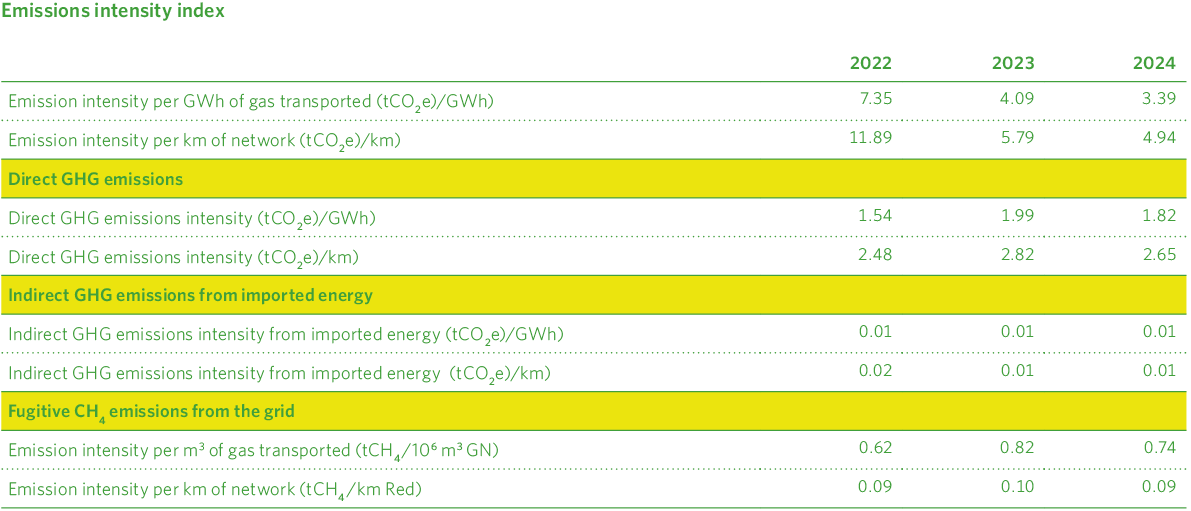
Madrileña Red de Gas conducts annual comparisons of emission intensity indices, particularly concerning Scope 1 and 2 emissions, to analyse its GHG emission performance.
The unit of activity established to present the inventory results in terms of emission intensity (tCO2e/UA) for evaluating achieved performance is:
- GWh of gas transported
- Km of gas network length
Once the calculation is complete, Madrileña Red de Gas proceeds with the verification of the data by an independent third party, thereby ensuring the transparency, rigor, and reliability of the results obtained. Subsequently, the results are communicated to the Spanish Office for Climate Change (OECC), which allows the organization to maintain its official “Calculo” seal.
Along with the annual reports, Madrileña Red de Gas submits an emission reduction plan to the OECC, outlining the planned and ongoing measures to decrease the organization’s environmental impact.
Furthermore, at the end of 2024, Madrileña Red de Gas conducted a new carbon footprint benchmark assessment with its counterparts. The main conclusion from this assessment is that its carbon footprint emissions are at levels similar to the rest of the sector.
Through these actions, Madrileña Red de Gas not only complies with current regulations but also reinforces its commitment to the progressive decarbonization of its operations and its active contribution to national and international climate objectives.
Other atmospheric pollutants
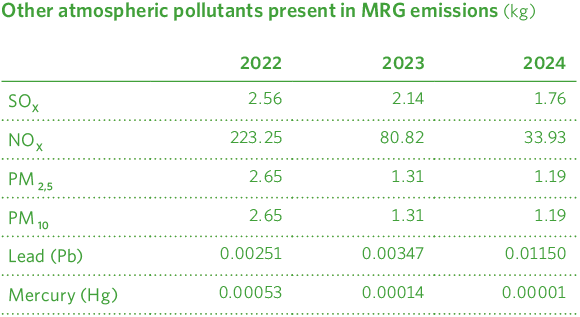
For calculating emissions from stationary sources, the EMEP/EEA methodology (EMEP/EEA Air Pollutant Emission Inventory Guidebook) is applied. This calculates emissions based on fuel consumption and emission factors for various pollutants, both determined by the technology used.
On the other hand, the methodology used for calculating combustion emissions from mobile sources is based on the approach outlined in the European Environment Agency’s technical report: COPERT IV (Computer Program to Calculate Emissions from Road Transport). This methodology applies emission factors for different pollutants, classified by vehicle typology, category (Euro Standards), and the fuel used.
Main mitigation actions for GHG emission reduction
Madrileña Red de Gas has implemented a series of actions aimed at climate change mitigation, focusing on the reduction of greenhouse gas (GHG) emissions. The main measures include:
- Methane Emission Reduction Plan (OGMP 2.0), in effect from 2023 to 2028, considering 9 general actions with 19 associated targets for 2024.
- Progressive transformation plan for LPG supply points to natural gas.
In addition, regarding the reduction of its methane emissions, Madrileña Red de Gas has carried out a comprehensive study to identify areas with a higher risk of infrastructure deterioration. This allows for more thorough monitoring of the condition of its distribution networks and enables appropriate maintenance.
MRG has implemented a series of actions aimed at climate change mitigation, focusing on the reduction of greenhouse gas (GHG) emissions
To achieve this goal, the soil acidity level was analyzed in detail in each of the municipalities where Madrileña Red de Gas’s distribution network is present. Corrosion is one of the processes that most affects buried metallic infrastructures. By identifying areas with greater corrosion, this document determined the degree of soil acidity, as this is one of the triggering factors for corrosion.


Finally, it is important to highlight that Madrileña Red de Gas not only strives to reduce its own emissions but also, through its core activity, displaces other more polluting fuels like diesel or propane. This reduces local and global emissions by promoting the use of natural gas by its customers, while also facilitating accessibility to the use of green gases.
8.2Resources and circular economy
Madrileña Red de Gas is committed to the circular economy as an essential part of its sustainability strategy. Therefore, it promotes the efficient use of resources through the use of durable products, waste reduction, and material reuse.
This commitment not only protects the environment but also generates economic and social value, guiding its decisions toward a more responsible and resilient model. Based on this, Madrileña Red de Gas established the following objective for 2024.
Resources
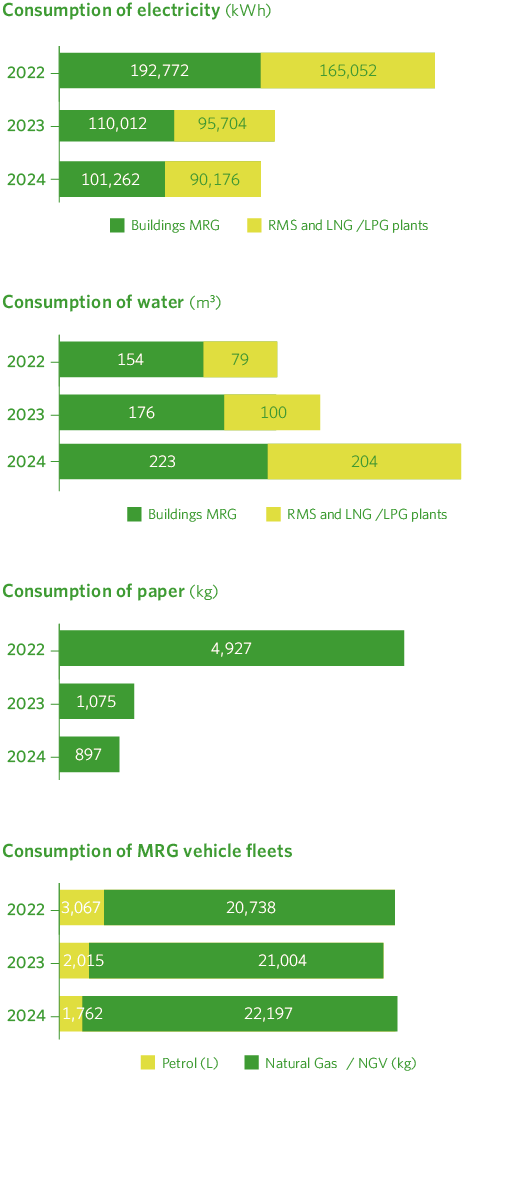
Within its Integrated Environmental Management System, Madrileña Red de Gas has a consolidated methodology for controlling and monitoring resource consumption. This ensures efficient and responsible management of natural and energy resources at its workplaces and industrial facilities, as well as fuel consumption in its vehicle fleet.
As the previous results show, water consumption has increased compared to previous years, particularly in the LNG and LPG facilities due to water used in inerting processes. Fuel consumption for the vehicle fleet remained similar to the prior year, while electricity consumption in buildings and facilities, as well as paper consumption, continued to decline significantly.
Regarding the decrease in electricity consumption, as mentioned earlier in the carbon footprint section, it’s expected that as the number of LPG plants belonging to Madrileña Red de Gas decreases, the associated consumption will also be reduced.
Furthermore, concerning paper consumption, Madrileña Red de Gas makes greater strides each year in the digitalization of its processes, which translates into a considerable reduction in paper consumed.
Waste management
To ensure its commitment to the circular economy and within its Integrated Environmental Management System, Madrileña Red de Gas has specific procedures for the proper management of waste.
The temporary storage of waste at the company’s facilities is carried out in a controlled manner, with special attention paid to those materials that could pose a risk of environmental degradation.

Furthermore, as part of its management philosophy, Madrileña Red de Gas ensures that activities performed by its contractors include the proper management of all waste generated during the provision of their services, aiming to simplify associated procedures as much as possible. To achieve this, relevant contractual clauses are incorporated into signed agreements, and suppliers are required to be legally authorized to perform such waste management.
Regarding the main waste generated at its facilities (such as regulation and metering stations, and LNG plants and LPG plants) these mostly originate from the maintenance operations, and include materials like greases, contaminated rags, used filters, among others.
MRG ensures that activities performed by its contractors include the proper management of all waste generated during the provision of their services
During 2024, the amount of non-hazardous waste generated increased significantly. This was primarily due to an increase in construction and demolition waste (a consequence of a higher number of projects in expansion activities) and, to a lesser extent, the dismantling of a total of 50 LPG plants, which is 13 more than in the previous year, resulting in the associated waste generation from this activity


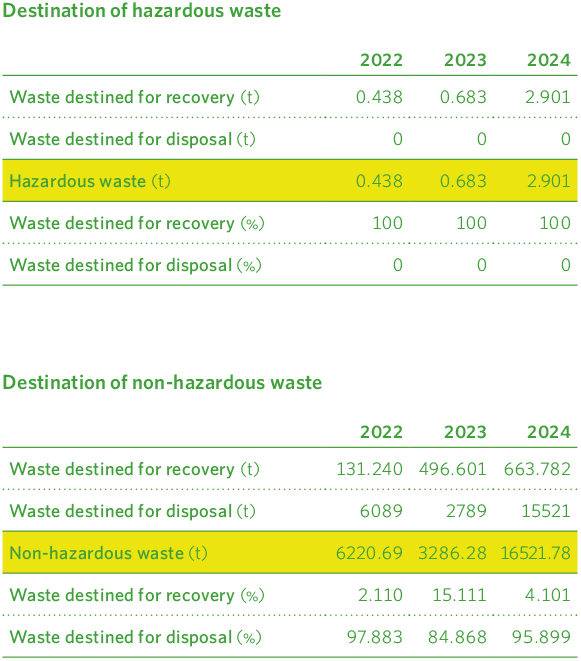
Madrileña Red de Gas is committed to minimizing waste generation and promoting waste recovery and recycling. They prioritize methods that reincorporate materials into the production cycle, thereby reducing environmental impact.
8.3Biodiversity
Commitment with biodiversity protection
Madrileña Red de Gas fully acknowledges the importance of preserving biodiversity as an essential element for ecosystem balance and environmental sustainability. The loss of biodiversity brings significant risks, such as species extinction, habitat fragmentation, and the degradation of ecosystem services that support both wildlife and human well-being.
Although their infrastructure’s presence in protected or high ecological value areas is very limited—since most of their facilities are located in urban or suburban environments—Madrileña Red de Gas maintains a strong commitment to protecting the natural surroundings. Therefore, rigorous environmental criteria are adopted during the design, construction, maintenance, and dismantling phases of their facilities to minimize any potential impact on the surrounding ecosystems.
Madrileña Red de Gas maintains a strong commitment to protecting the natural surroundings. Therefore, rigorous environmental criteria are adopted during the design, construction, maintenance, and dismantling phases of their facilities
In this regard, every dismantling activity has a Technical Director responsible for approving the construction and demolition waste management plan developed by the contractor at the start of the work and for signing the final work certificate.
Furthermore, in actions that may occur in sensitive areas, potential impacts on flora, fauna, and habitats are assessed beforehand, integrating preventive, corrective, and compensatory measures into the respective projects. This proactive environmental management is part of Madrileña Red de Gas’s corporate responsibility approach and is structured through its Integrated Environmental Management System, in line with sustainability principles and respect for the natural environment.
Madrileña Red de Gas has fully restored the surface area previously occupied in protected or high ecological value spaces, meaning they now have no facilities located in such areas
Madrileña Red de Gas currently operates 18 LPG satellite plants and 6 LNG plants that bring gas to homes not reached by the distribution network. In this regard, and compared to the previous year, Madrileña Red de Gas has fully restored the surface area previously occupied in protected or high ecological value spaces, meaning they now have no facilities located in such areas
Management of contaminated soils and environmental responsibility
Madrileña Red de Gas systematically collects data and, if necessary, samples required to prepare the mandatory Contaminated Soil Closure Report. These reports are submitted to the competent authority of the Community of Madrid, which evaluates the information and issues the corresponding administrative resolution. This procedure ensures that the company’s activities comply with current regulations on soil protection and pollution prevention, guaranteeing proper closure and rigorous control of the environmental status of the sites involved.
Additionally, regarding potential environmental damages that could arise from the operation of its facilities, Madrileña Red de Gas is subject to the provisions of Law 26/2007 on Environmental Responsibility. This legislation imposes a series of obligations on operators, including immediate notification to the competent authority of any environmental damage or imminent threat thereof, as well as the implementation of necessary measures to prevent, avoid, and, where appropriate, repair the damage caused.
Madrileña Red de Gas maintains a proactive stance in fulfilling these obligations, integrating the principles of precaution and prevention into its operational procedures and environmental management. All of this aims to ensure environmental protection and respond effectively to any environmental contingency that may arise.