
4.1 ESG strategy
M Madrileña Red de Gas works daily with a strong commitment to sustainability, integrating it transversally at all levels of the organization.
Aware of the impact of its actions on sustainable development, in 2024 Madrileña Red de Gas published its Sustainability Policy, aimed at establishing the principles of action and commitments assumed by the company in terms of sustainability, with a clear objective of generating shared value with its stakeholders, both now and in the long term, and an undeniable responsibility for the possible impacts linked to its activity as a gas distributor.
On the other hand, the energy transition, although it may represent a challenge, is also a valuable opportunity for the future of the company and for the planet. The company’s goal is to be a benchmark in the fight against climate change, firmly committed to promoting renewable energy alternatives, such as biomethane and hydrogen, that enable progress toward a cleaner and more efficient energy model.
The energy transition, although it may represent a challenge, is also a valuable opportunity for the future of the company and the planet.
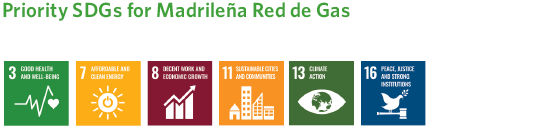
Madrileña Red de Gas focuses its strategy and integrates sustainability principles into all areas of the company, aligning its operations, products, and services with the Sustainable Development Goals (SDGs)
Additionally, Madrileña Red de Gas wants to be fully prepared for upcoming regulatory and market changes, always ensuring access to reliable and continuous energy. Through its constant action, it seeks not only to strengthen its position in the sector but also to contribute to building cleaner and more sustainable cities, thereby earning the trust and recognition of the public.
Furthermore, Madrileña Red de Gas focuses its strategy and integrates sustainability principles into all areas of the company, aligning its operations, products, and services with the Sustainable Development Goals (SDGs).
To that end, Madrileña Red de Gas has evaluated and directly contributes to those SDGs most aligned with its mission, vision, values, and operations, with the goal of generating real and positive impacts.

GRESB: A seal of leadership in sustainability
After hard work and commitment to sustainability, Madrileña Red de Gas has achieved first place globally, in Europe, and in Spain according to the renowned Global Real Estate Sustainability Benchmark (GRESB).
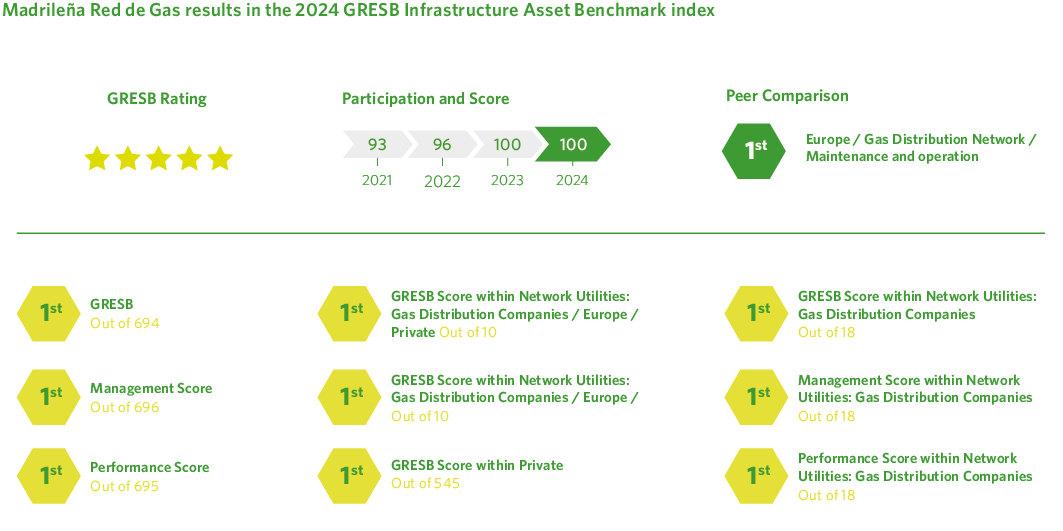
After nine consecutive years of participation and with outstanding scores in the previous three editions (93, 96, and 100), Madrileña Red de Gas has once again secured its sector leadership with the highest possible score: 100 out of 100 points. This achievement allows the company to renew, for the fourth consecutive year, the prestigious 5-star rating, which is awarded only to the top 20% of companies with the best scores in the GRESB assessment.
Madrileña Red de Gas has achieved first place globally, in Europe, and in Spain according to the renowned Global Real Estate Sustainability Benchmark (GRESB)
In its 2024 edition, the GRESB infrastructure assessments included 720 companies from all sectors across 81 countries, making the recognition awarded to Madrileña Red de Gas even more significant within a highly competitive global context.
Furthermore, these results provide insight into the company’s progress compared to previous years as well as its maturity level in ESG (Environmental, Social, and Governance) best practices, both internally and relative to other companies in the same sector.
For Madrileña Red de Gas, being number one in GRESB is a crucial achievement that reflects an exemplary commitment to sustainability. It not only enhances the company’s reputation and trust with investors and clients but also opens new business opportunities, facilitates access to green financing, and attracts investors committed to sustainability. In a market focused on environmental responsibility, leading in GRESB becomes a key competitive advantage.
Sustainability award in the Corporate Awards 2024
Reinforcing the achievement of attaining the highest rating in the 2024 GRESB Index, and alongside its strategy to reach the Net Zero target by 2050, Madrileña Red de Gas has been honored with the Sustainability Award granted by Corporate magazine, highlighting its leadership in the implementation of sustainable practices.
Madrileña Red de Gas has been honored with the Sustainability Award granted by Corporate magazine, recognizing its leadership in the implementation of sustainable practices.
The Corporate Awards, organized by Corporate magazine since 2021, recognize individuals and companies that have significantly driven the country’s economic and business development in the 21st century.
This award reaffirms Madrileña Red de Gas’s commitment to sustainability and its focus on strategies that promote the reduction of pollutant emissions and improve energy efficiency, generating benefits for the communities it serves.
Madrileña Red de Gas participates in the National Environmental Congress 2024
Last Thursday, December 5th, Madrileña Red de Gas took part in a new edition of the National Environmental Congress (CONAMA). The Risk Management Officer, Alfonso García Juncal, spoke during the technical session dedicated to sustainability reporting standards and frameworks.
Alongside companies such as Ilunion Hoteles and Sacyr, Madrileña Red de Gas shared its experience in the field of sustainability, highlighting the progress made to date and its approach to tackling the challenges posed by new reporting regulations, especially concerning the entry into force of the CSRD Directive.
This participation reaffirms Madrileña Red de Gas’s commitment to transparency, continuous improvement, and leadership in corporate sustainability.
Turing project: decisions driven by data
In an increasingly dynamic and competitive business environment, being a data-driven organization is not an option but a necessity. Madrileña Red de Gas embraces a culture where data is the core of every decision, strategy, and operation.
Through the Turing project, a strategic initiative launched in 2024, Madrileña Red de Gas aims to become a data-driven organization. Supported by top management, the goal is to train an internal specialized team to drive the use of data in decision-making.
This team will act as a catalyst for cultural and technological change within the organization, promoting best practices, identifying improvement opportunities based on data, and supporting different departments in their transformation towards more analytical, efficient, and proactive management.
Direct sponsorship from leadership ensures alignment with the company’s strategic objectives and reinforces the commitment to a vision based on evidence, transparency, and continuous improvement.
As part of the project, a Data Lake is being developed—a centralized repository that stores the company’s key information. This environment continues to grow with relevant data for each business area. Historical data has already been incorporated, and a glossary of terms has been published to unify criteria and facilitate data understanding. In the next phase, each business unit will have structured access to its own tables.
Additionally, a three-year master plan has been designed that includes training the team in data strategy and analysis to foster a culture based on data use throughout the organization. This plan also addresses data governance and quality, report standardization, and data-driven decision-making.
Furthermore, potential applications of artificial intelligence and predictive analytics are being identified to optimize and make business processes more efficient.
In summary, Madrileña Red de Gas is an organization that not only collects data but analyzes it, puts it into action, and transforms it into a long-term competitive advantage.
Compliance with the new sustainability standards
During 2024, Madrileña Red de Gas has made a significant effort to prepare for and adapt to the Corporate Sustainability Reporting Directive (CSRD), following a meticulous and strategic process to comply with the new sustainability and transparency requirements established by the European Union.
This directive, aimed at improving the quality, consistency, and comparability of sustainability-related information, requires companies to provide more detailed reports on their environmental, social, and governance practices.
During 2024, Madrileña Red de Gas has made a significant effort to prepare for and adapt to the Corporate Sustainability Reporting Directive (CSRD)
The first step in this process was a thorough study of the CSRD requirements, carefully analyzing the new guidelines, scope, and potential impact of the directive on internal policies.
Once the requirements were understood, the next step involved conducting a gap analysis to assess the difference between the company’s current sustainability practices and the new requirements established by the CSRD.
To carry out this gap analysis, all disclosure requirements of the ESRS (European Sustainability Reporting Standards) were meticulously reviewed. These technical standards, developed by EFRAG (European Financial Reporting Advisory Group), regulate the sustainability information companies must disclose to implement the CSRD. While the CSRD mandates companies to disclose sustainability information, the ESRS specify what must be reported and how it should be presented.
In this way, Madrileña Red de Gas has evaluated its level of compliance with these standards and identified which information meets the requirements and which areas need improvement or adjustment.
In parallel, Madrileña Red de Gas participated in the pilot phase of the Global Reporting Initiative (GRI) alignment support service for GRI-ESRS integration. Through this collaboration, GRI Report Services analyzed the GRI Content Index from the company’s previous sustainability report, with the aim of providing Madrileña Red de Gas with a tailored alignment review of the requirements for a GRI-reporting organization.
As a result, Madrileña Red de Gas received guidance on useful resources to support future ESRS reporting, as well as a summary of how its GRI disclosures align with ESRS requirements, including additional notes and comments on the information provided. The company also received a list of ESRS data points that were not aligned with its current GRI disclosures.

SFDR report
For the second consecutive year and during the first quarter of the year, Madrileña Red de Gas provided the information requested by its shareholder PGGM, based on the disclosure requirements of the Sustainable Finance Disclosure Regulation (SFDR).
The SFDR is a regulation of the European Union aimed at increasing transparency in sustainable investments. It requires financial entities and asset managers to disclose information on how their products and services impact sustainability, specifically regarding environmental, social, and governance (ESG) factors. The objective is to enable investors to make informed decisions about the sustainability implications of their investments, thereby promoting a more responsible financial sector aligned with global climate and social goals.
Sustainability maturity: comparative analysis
During the last quarter of 2024, a new comparative analysis was conducted to assess the sustainability maturity level of the country’s leading gas distribution companies. The study focused on the three core pillars of sustainability: corporate governance, environmental performance, and the social dimension.
To carry out the analysis, publicly available information from the sector’s top companies was used. The primary objective of this comparison is to identify development and improvement opportunities within each of the sustainability vectors analyzed, thus highlighting both strengths and existing gaps.
In addition, the results provide a valuable benchmark to promote best practices, foster transparency, and support strategic decision-making aimed at driving a sustainable and responsible transition within the sector.
4.2Materiality analysis
Double materiality is a key concept in the new Corporate Sustainability Reporting Directive (CSRD), which requires companies not only to disclose the environmental, social, and governance impacts of their activities, but also to report on how these factors may affect their financial performance.
In line with this, throughout 2024, Madrileña Red de Gas has been working on a double materiality assessment, following the recommendations established by EFRAG, to ensure that the sustainability report complies with the new directive’s requirements. This approach—which integrates both financial and environmental/social perspectives—enables the company to identify the most relevant and significant topics, both in terms of their impact on the company’s performance and on society and the environment.
As the process is still ongoing, this report retains the materiality analysis from the previous reporting year. That assessment was carried out based on the criteria established in the GRI standards—specifically GRI 3: Material Topics 2021—and considered the thematic standard GRI 11: Oil and Gas Sector 2021.
The material topics were identified and prioritized through a participatory process that involved evaluating and selecting the most relevant issues for the organization and its stakeholders. This process assessed the positive and negative, actual and potential impacts of Madrileña Red de Gas’s activities on the economy, people, and the environment (outside-in), as well as the impact of these topics on the company’s business performance and outlook (inside-out).
The results of the materiality analysis enable Madrileña Red de Gas to focus its efforts on the topics of greatest relevance (i.e., material topics), both for its performance and for long-term sustainability
In this context, in 2024, the company approved an internal procedure for conducting materiality assessments. This procedure sets out the necessary guidelines and steps to evaluate and determine the most relevant aspects for the organization. It ensures a systematic and structured approach to identifying and assessing the key elements that significantly affect Madrileña Red de Gas’s decisions and operations. For more detailed information on the materiality analysis process, please refer to the previous year’s sustainability report (https://sostenibilidad-2023.madrilena.es/nuestro-compromiso-con-la-sostenibilidad/).
The results of the materiality analysis enable Madrileña Red de Gas to focus its efforts on the topics of greatest relevance (i.e., material topics), both for its performance and for long-term sustainability

4.3Sustainability master plan 2023-2026
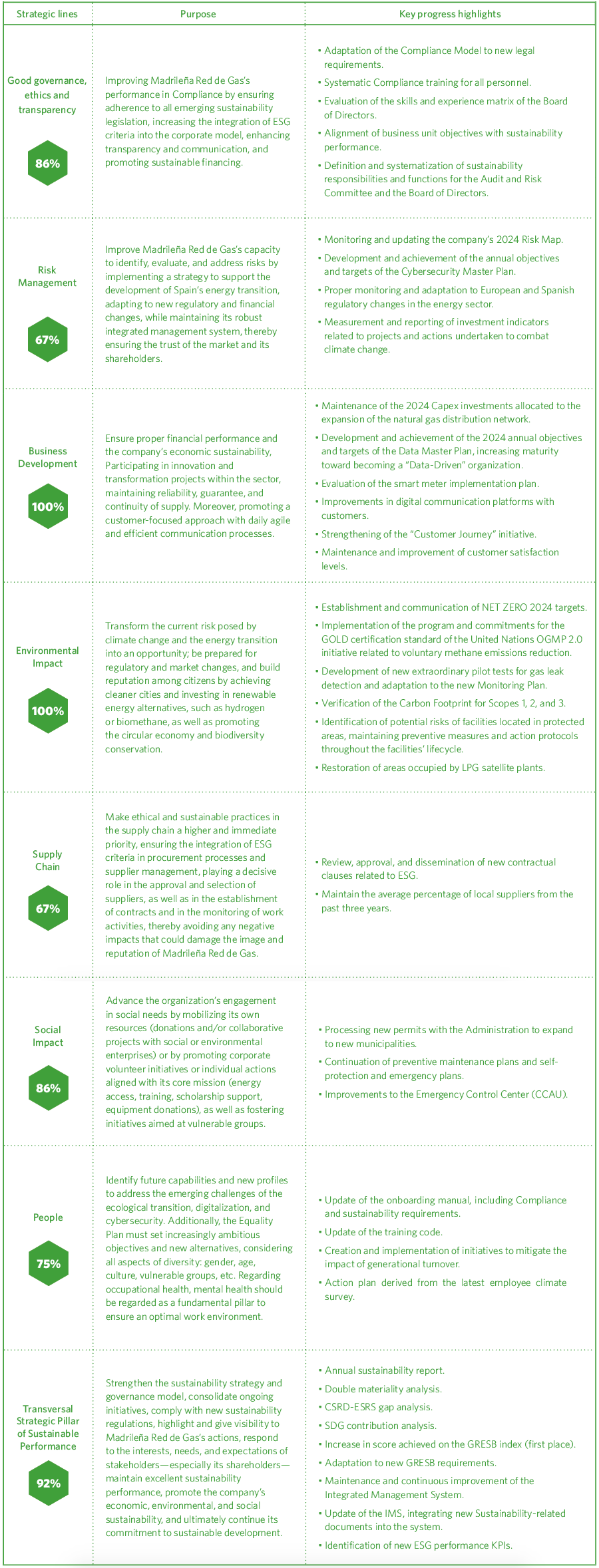
Based on the context analysis and the double materiality assessment, Madrileña Red de Gas defined a Sustainability Master Plan for the 2023–2026 period, with the goal of addressing the challenges of the energy transition and climate change through a sustainable business model focused on long-term value creation and commitment to people and customers.
The Sustainability Master Plan of Madrileña Red de Gas is a roadmap to address the challenges of the energy transition and climate change through a sustainable business model based on long-term value creation and commitment to people and customers
The Plan is structured around strategic pillars and lines of action, which in turn are deployed through a set of actions and targets for the four-year period. The goals are aligned with the company’s objectives and strategy, taking into account:
- The main trends in sustainability.
- Material topics and subtopics for the company.
- Requirements set by the GRESB index and the OGMP 2.0 initiative.
- Commitments made to stakeholders.
- Contribution to the company’s priority Sustainable Development Goals (SDGs).
The Sustainability Master Plan of Madrileña Red de Gas is a roadmap to address the challenges of the energy transition and climate change through a sustainable business model based on long-term value creation and commitment to people and customers.
Eight strategic pillars have been established, corresponding to the seven material topics identified, plus a cross-cutting pillar that is common to all of them.
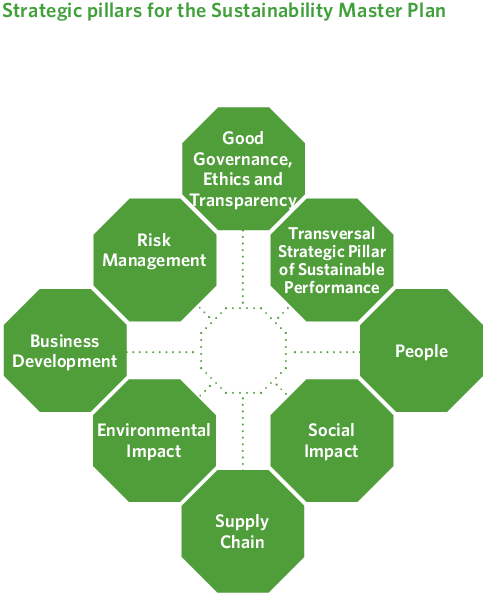
The lines and actions linked to each pillar have clear purposes to address the sustainability challenges presented, both to tackle impacts as well as risks and opportunities.
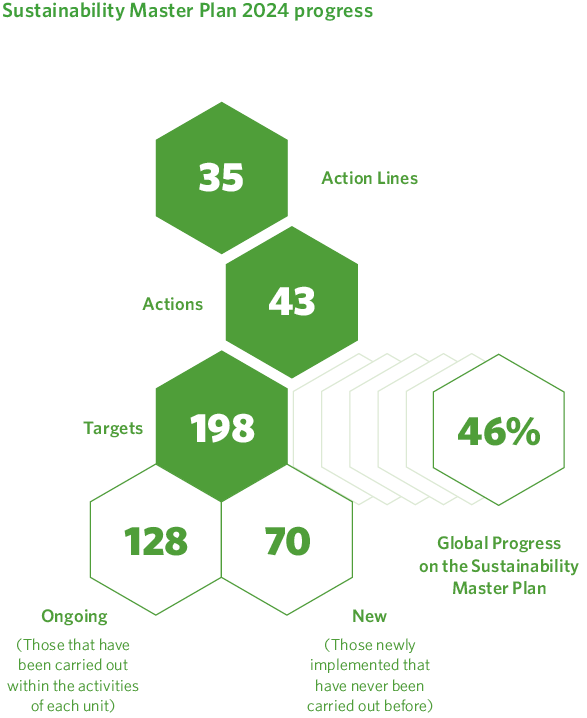
As indicated, the action lines are broken down into 43 actions, which in turn encompass 198 targets. For each of these, the responsible departments for execution have been identified, as well as the primary material or relevant topic to which they contribute.

To plan the work for the 2023–2026 period, key factors considered included the current level of performance, the impact versus effort required to address each action, the resource needs to carry out the activities, and whether it was a mandatory requirement. In all cases, a balance was sought in the distribution of responsibilities among the different departments tasked with implementing the actions, as well as alignment with other strategic plans and initiatives.
The prioritization of material topics, the current performance level, the existence or absence of legal or regulatory requirements to be met, and the resources needed to carry out the activities were the fundamental elements for prioritizing and planning the work over the four-year scope of the Plan. In every case, efforts were made to ensure an equitable workload among the departments responsible for executing the actions during the 2023–2026 horizon.
The Risk Management Unit is responsible for preparing and monitoring the Plan. At least once a year, a global evaluation of progress on activities and targets is conducted, while the main actions are assessed at least semiannually to report and supervise through the Audit and Risk Committee, based on information provided by the different organizational units.
The Audit and Risk Committee, as the governing body responsible for integrating sustainability into the Company’s strategy, supports the execution and monitoring of the Plan by issuing recommendations as necessary and conveying information to the Board of Directors for its approval and inclusion in decision-making.
At the midpoint of the Plan’s duration, the performance rate is 46% of actions completed and 2% in progress
At the midpoint of the Plan’s duration, the performance rate is 46% of actions completed and 2% in progress. It is worth noting that, primarily due to the gradual evaluation and application of the CSRD directive requirements and the ESRS standards—both for Madrileña Red de Gas and subsequently for the Madrileña Group—and secondly due to their potential non-application following the emergence of the Omnibus law, some actions were paused. These have either been postponed to the second half of the Plan or are being reconsidered. For this reason, in 2025 a review of actions will be carried out in light of the new sustainability context and the voluntary commitments assumed by the company.
4.4Stakeholder engagement model
Madrileña Red de Gas has a Stakeholder Model governed by the following principles:
- Value creation: delivering value to stakeholders through the development of a sustainable business model.
- Identification of needs and expectations: incorporating the most relevant ones into the company’s strategy.
- Communication: conveying the sustainability strategy, social responsibility behaviors, and commitments made to stakeholders.
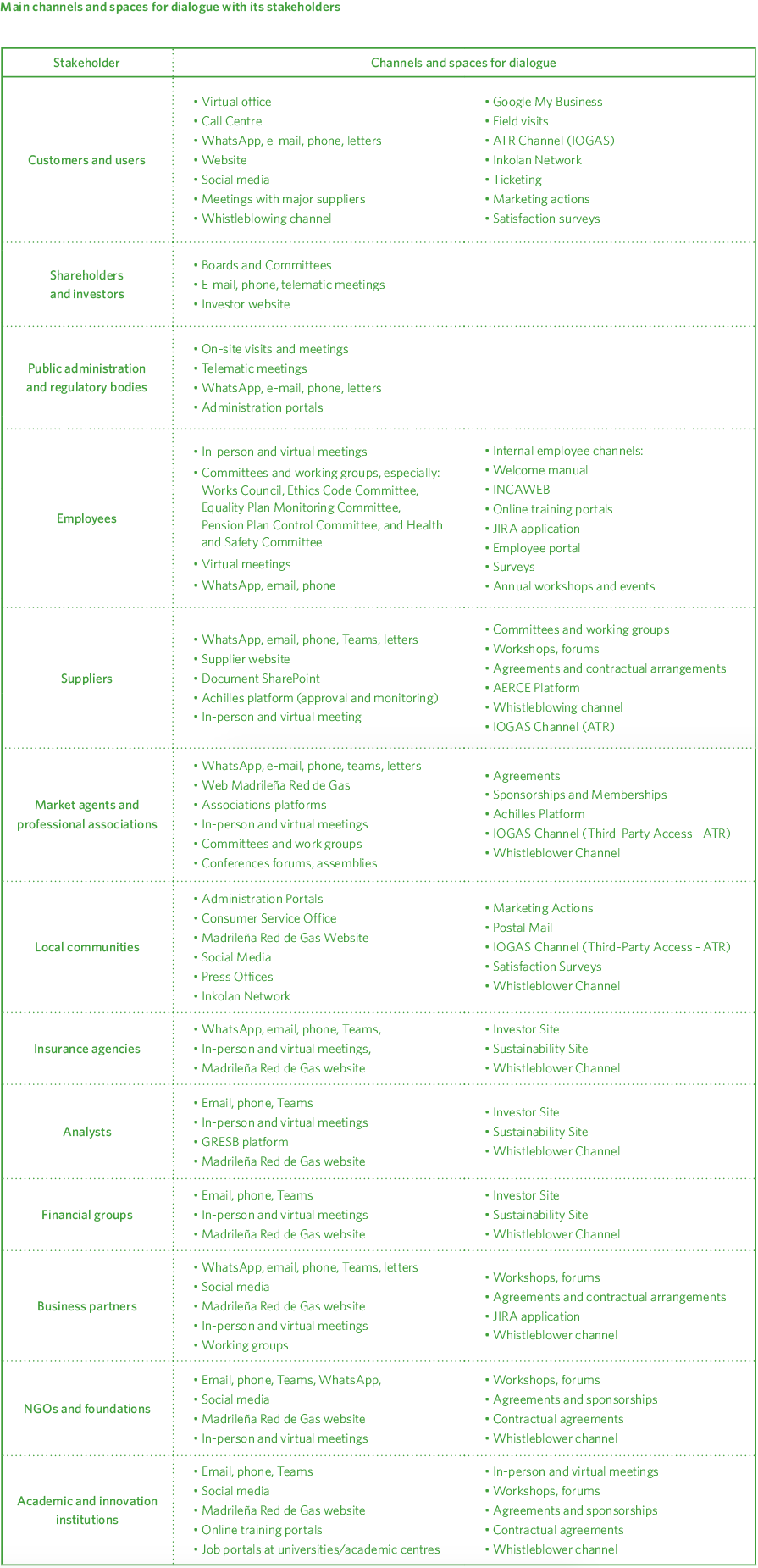
- Channels and dialogue: Madrileña Red de Gas provides its stakeholders with the necessary channels to manage requests for information, opinions, complaints, and claims, and establishes dialogue mechanisms to address their requirements and expectations.
- Continuous improvement: within the social responsibility management system, periodic evaluation and review mechanisms are established for the stakeholder management model.
To meet the needs and expectations of its stakeholders, Madrileña Red de Gas has developed its Stakeholder Engagement Model, which aims, among other objectives, to systematize relationships with stakeholders and foster a corporate culture focused on the importance of dialogue and transparency with stakeholders.
This year, there have been no substantial changes in the inventory and prioritization of stakeholders compared to previous years. It is worth highlighting the review of impacts on people and the environment within the framework of the different stakeholder groups, as well as the associated risks and opportunities, in the context of the double materiality process under CSRD-ESRS requirements.
Aligned with the stakeholder collaboration and engagement strategy, various lines of action have been developed, which are detailed throughout this report in the corresponding chapters.
Engagement and communication channels
As part of its commitment to dialogue, transparency, and accountability, Madrileña Red de Gas has built a framework of trust with its stakeholders by strengthening and maximizing established communication channels, ensuring transparency in its relationships, and sharing truthful, appropriate, relevant, clear, and useful information—without compromising the integrity of such information, given the regulated nature of its activity
As part of its commitment to dialogue, transparency, and accountability, Madrileña Red de Gas has built a framework of trust with its stakeholders by strengthening and maximizing established communication channels
The identification of interests, needs, and expectations is carried out continuously through communication and dialogue via the established channels between the various organizational units of Madrileña Red de Gas and the stakeholders with whom they engage. Beyond day-to-day interactions, the Risk Management Unit periodically conducts a deeper analysis through internal interviews to assess the stakeholder relationship and review the stakeholder engagement model.
This analysis is conducted every three years; the next review is scheduled for 2025, in conjunction with a more in-depth materiality assessment. This process will also include in-depth interviews with stakeholders to assess their concerns regarding the Company, their expectations and needs, and their assessment of its performance.
In addition to the regular dialogue and materiality assessments, periodic satisfaction surveys are conducted, particularly with critically important stakeholders. In 2024, the most recent employee climate survey was conducted, achieving outstanding results that surpassed those of previous years. In 2025, the implementation of the corresponding action plan will be carried out.
The shareholder engagement framework is established through the Board of Directors and through ad hoc meetings in which their concerns, interests, and expectations are conveyed. These meetings also serve as a channel to communicate and assess the deployment of the Company’s strategy and performance. Notably, two meetings outside the regular framework were held in 2024, mainly aligned with PGGM’s sustainability requirements and their conducted Due Diligence.
Based on customer demand analysis and navigation behavior, a new website was launched in 2024, designed to facilitate access to information, improve transparency and accessibility (with a “Mobile First” design)
Based on customer demand analysis and navigation behavior, a new website was launched in 2024, designed to facilitate access to information, improve transparency and accessibility (with a “Mobile First” design), and serve as a platform for news and key information of interest to various stakeholders. It focuses on the needs of customers and the commitments Madrileña makes to them, offering the possibility to interact via the website and the virtual office for operations, claims, and information requests.
Additionally, the investor site has been updated to include relevant information in English regarding the organization, documentation, and key events that may be of interest to debt investors, analysts, shareholders, or key regulatory institutions.
In 2024, Madrileña Red de Gas further enhanced the communication content on its corporate website, particularly on the sustainability section (https://madrilena.es/sostenibilidad/), where it shares its commitments to good governance, the environment, and people. The site also publishes the main policies related to sustainable development.
Additionally, the website publishes both the annual financial reports and the Sustainability Report each year, following the Global Reporting Initiative – GRI standard. This report includes all the most relevant non-financial information about the company, including specific requirements for companies in the oil and gas sector, and complements the information contained in the Annual Report. The Sustainability Report has been verified by an independent third party. Furthermore, the main certifications and recognitions in these areas are also shared.
Similarly, concerns regarding business conduct are addressed through the whistleblowing channel or the irregularities reporting channel.
Furthermore, and in line with the company’s commitment to sustainability, the interests, needs, and expectations of stakeholders are addressed through their participation in the materiality assessment process and the systematic satisfaction surveys conducted with the company’s key stakeholder groups.
The web channel for collaborators, through the installers’ area, facilitates easy access to CUPS information, management of customer requests, and information on commercial campaigns.
Another key communication and dissemination channel for all stakeholders—particularly opinion leaders—is the news section of the company website and the active participation in social media platforms (LinkedIn, Facebook, WhatsApp groups, etc.), where updates are shared regarding the company’s progress, energy transition efforts, renewable gases, relevant projects and initiatives, customer recommendations, and more.
All communication channels and stakeholder dialogue platforms also serve as spaces where stakeholders can raise claims, request advice, or express concerns about corporate conduct and the impact of the company’s activities. These include, for example, dialogue with local communities to improve social license, the call center, virtual office, intranet, whistleblower hotline, and grievance channel for reporting legal or due diligence violations. The mechanisms governing these channels are described in detail in the relevant chapters of this report.
The stakeholder group Customers, as the company’s core focus, continues to be central to the strategies and commitments of Madrileña Red de Gas. This group remains the top priority in the improvement projects implemented by the organization.
Among the key initiatives, the company has continued working on enhancements to the virtual office, aiming to simplify access to procedures and expedite the availability of necessary documentation for both customers and installers. These improvements have led to a significant reduction in service response times.
Furthermore, with a focus on improving customer service during the gas activation process, Madrileña Red de Gas has implemented a proactive measure: resolving minor defects in older installations during the same service visit. This approach prevents customers from incurring unexpected costs, as the distributor assumes the related expenses. It also contributes to operational efficiency by reducing the number of visits required to activate service. Additionally, customer interaction channels have been expanded and strengthened, with WhatsApp becoming a steadily growing and widely accepted communication tool among users.
Chapter 9, Social Impact, provides a detailed overview of all efforts made by the company in 2024 to address customer needs and improve satisfaction.
The energy transition represents a major challenge for Madrileña Red de Gas in its role as a distributor, requiring the progressive adaptation of its networks and services for the distribution of renewable gases. This process entails closer and stronger relationships with business partners and market players.
As a member of industry associations such as SEDIGAS, AGREMIA, GASNAM, and OGMP, the company actively collaborates through memberships and participation in committees and working groups to defend the interests of the gas sector and to promote initiatives aligned with European sustainability goals and a favorable regulatory environment. Through this participation, Madrileña Red de Gas actively contributes to the energy transition by promoting the use of renewable gases and clean technologies (such as gas applications, mobility, etc.) and by positioning itself as a committed agent for decarbonization and energy efficiency at regional, national, and European levels.
MRG actively contributes to the energy transition by promoting the use of renewable gases and clean technologies (such as gas applications, mobility, etc.) and by positioning itself as a committed agent for decarbonization and energy efficiency at regional, national, and European levels
In addition, the company has long participated in initiatives promoted by public entities and professional associations, including FENERCOM and the Community of Madrid (Hydrogen Roundtables), as well as in other strategic sectors such as real estate, manufacturers, and installers (ANFAC and CONAE). These collaborations share the common objective of advancing a sustainable and efficient energy transition, strengthening the regional business fabric, and positioning gas as a key vector in achieving energy transition goals.
The consolidation and development of these projects reflect the essential value of teamwork. The results achieved to date—as well as their contribution to the effective management of future challenges—are analyzed in detail in the Risk Management chapter.
Also framed within the alliances established to support the energy transition, the company has been strengthening its relationships with academic and innovation institutions in recent years. A collaboration agreement is in place with Universidad Francisco de Vitoria to develop, implement, maintain, and jointly operate a renewable hydrogen storage and supply infrastructure in one or more of the university’s buildings. These agreements and partnerships are discussed in greater detail in Chapter 5. Another notable example is the collaboration with the Instituto de Ingeniería del Conocimiento (IIC), an expert in data analysis and Big Data technologies, with whom Madrileña Red de Gas works to predict annual gas distribution and optimize service management.